WNBA Primer: 2026 FIBA Women's Basketball World Cup
The 2026 WNBA season may be on pause, but action hasn’t stopped as nearly a quarter of the league heads to Berlin to battle for gold at the 2026 FIBA Women’s Basketball World Cup.
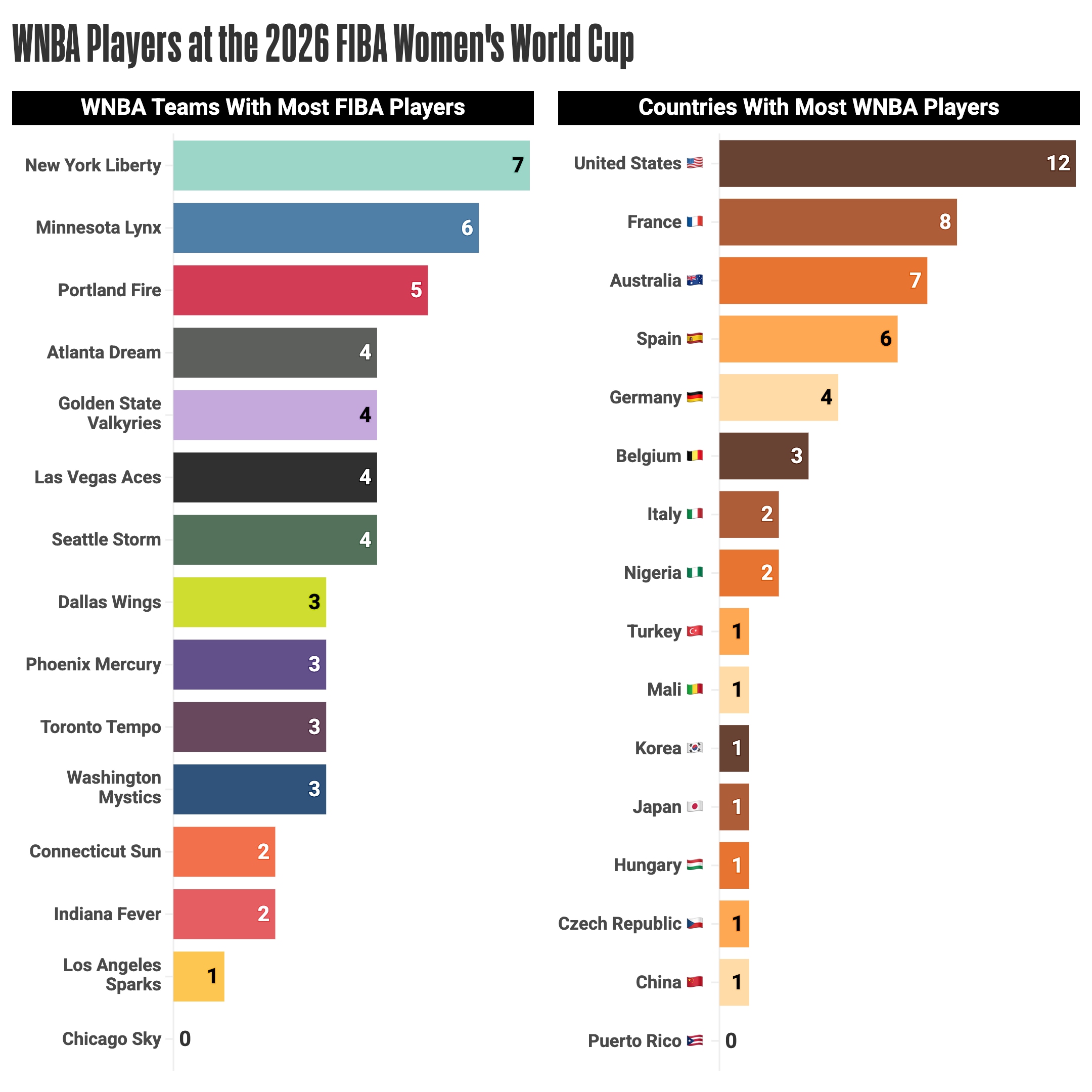
A total of 51 WNBA players (23.5% of the 217 rostered players) will participate in the competition, which tips off on Friday and runs through Sunday, Sept. 13. Those 51 players represent 14 of the WNBA’s 15 teams and 15 of the 16 nations competing from North America, Europe, Africa, and Asia.
It’s fitting that in the same year that the WNBA expanded to 15 teams (en route to 18 by 2030), the FIBA Women’s World Cup expanded its tournament from 12 teams to 16 teams for 2026. Both instances highlight the growing popularity of the women’s game worldwide.
When the WNBA tipped off its 30th season in May, opening-night rosters featured a record number of international players. This influx of global talent was made possible by the addition of two teams—the Fire and Tempo—along with expanded rosters under the new Collective Bargaining Agreement.
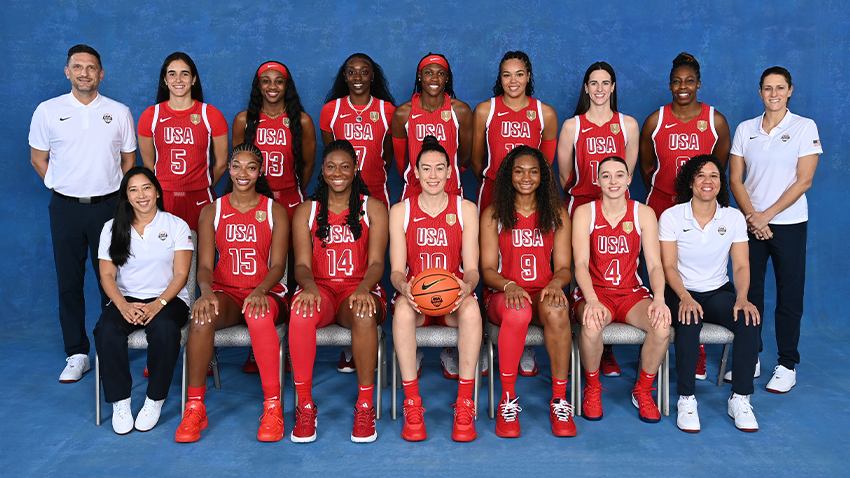
This year’s FIBA Women’s World Cup looks to build on that momentum over the next 10 days, headlined by a stacked United States squad seeking a fifth straight World Cup gold. Here’s everything you need to know to be ready for the competition to begin.
The Competition
The 16 participating teams have been divided into groups of four. During the Group Phase, each team faces the other three in its group, and the group winner automatically advances to the quarterfinals.
- Group A: Japan, Spain, Germany, Mali
- Group B: Hungary, Korea, Nigeria, France
- Group C: Belgium, Australia, Puerto Rico, Turkey
- Group D: USA, Czech Republic, Italy, China
The teams finishing second and third in each group will compete in a play-in qualification round with cross matchups between Groups A and B, and between Groups C and D. The victors secure the remaining quarterfinal spots against the group winners.
From there, it is a single-elimination bracket, with the quarterfinals on Sept. 10, the semifinals on Sept. 12, and the championship and third-place games on Sept. 13.
WNBA Players On National Team Rosters
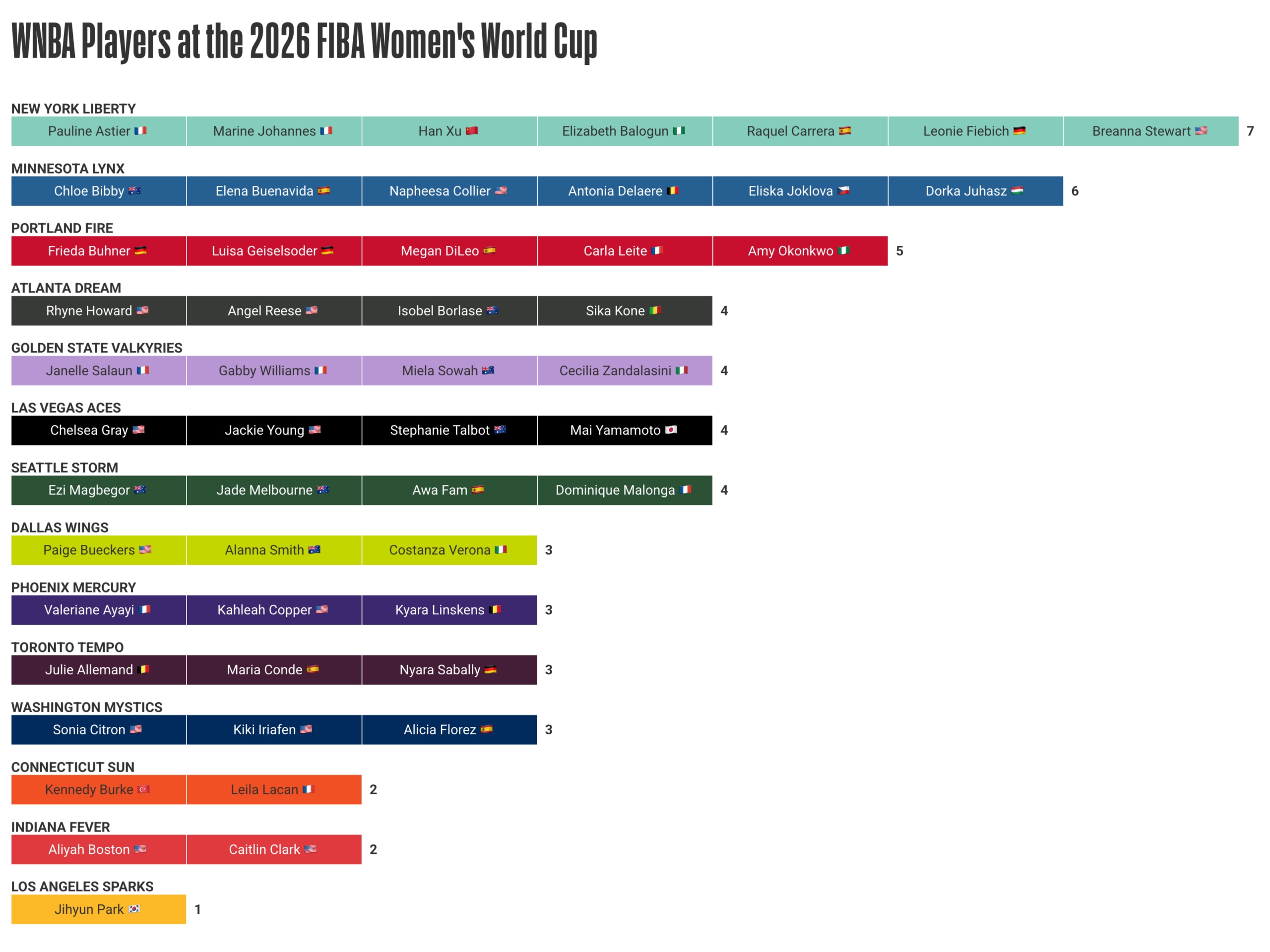
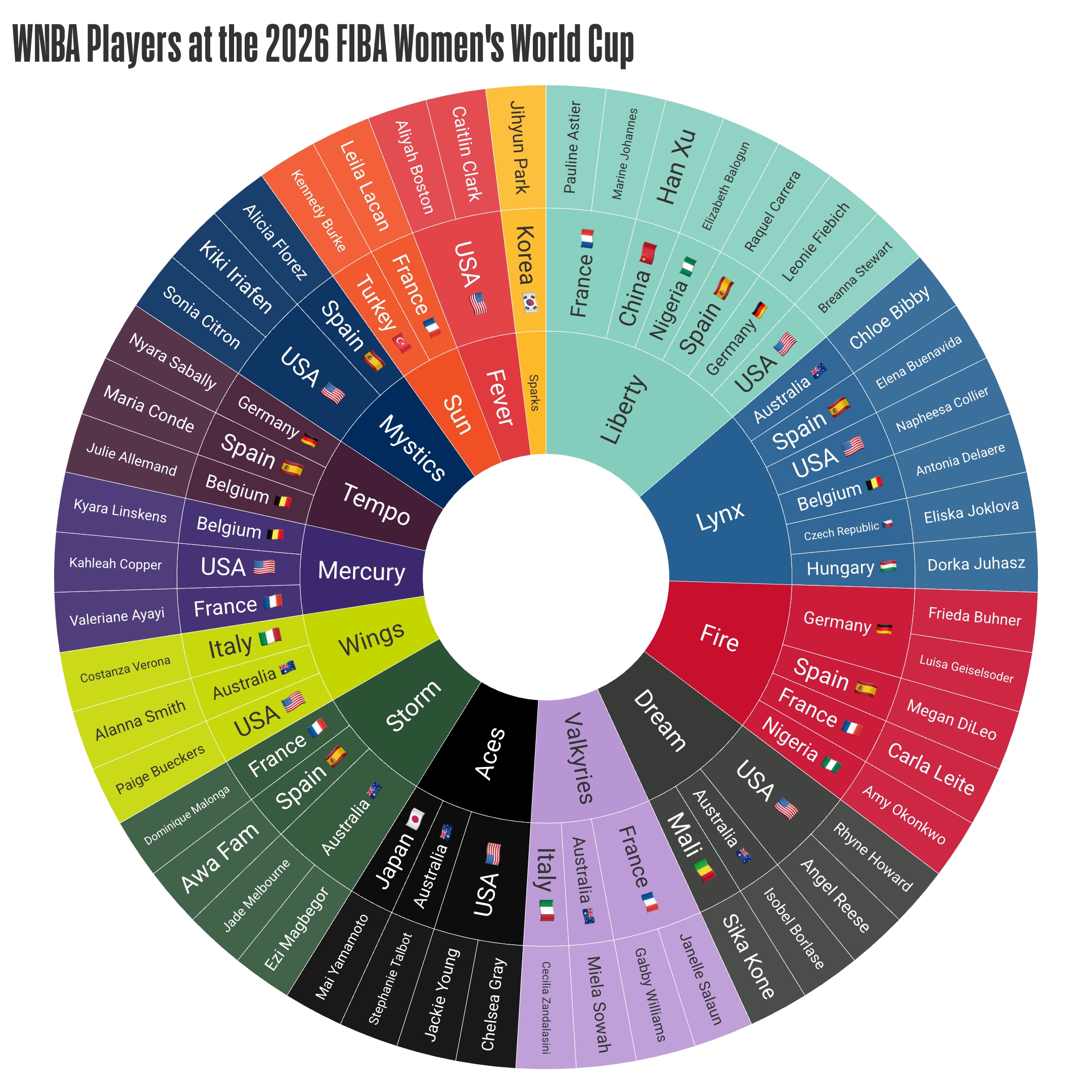
Nearly every WNBA team will be represented at this year’s World Cup, with the New York Liberty sending half of their 14-player roster to Berlin. Those seven Liberty players represent six different countries in the tournament, including a head-to-head matchup between USA’s Breanna Stewart and China’s Han Xu in the Group Play opener for both teams.
🇺🇲 United States (12 players)
- Aliyah Boston (F/C, Indiana Fever)
- Paige Bueckers (G, Dallas Wings)
- Sonia Citron (G, Washington Mystics)
- Caitlin Clark (G, Indiana Fever)
- Napheesa Collier (F, Minnesota Lynx)
- Kahleah Copper (F/G, Phoenix Mercury)
- Chelsea Gray (G, Las Vegas Aces)
- Rhyne Howard (G, Atlanta Dream)
- Kiki Iriafen (F, Washington Mystics)
- Angel Reese (F, Atlanta Dream)
- Breanna Stewart (F, New York Liberty)
- Jackie Young (G, Las Vegas Aces)
🇫🇷 France (8 players)
- Pauline Astier (G, New York Liberty)
- Valeriane Ayayi (F, Phoenix Mercury)
- Marine Johannès (G, New York Liberty)
- Leïla Lacan (G, Connecticut Sun)
- Carla Leite (G, Portland Fire)
- Dominique Malonga (C, Seattle Storm)
- Janelle Salaün (F, Golden State Valkyries)
- Gabby Williams (G, Golden State Valkyries)
🇦🇺 Australia (7 players)
- Chloe Bibby (F, Minnesota Lynx)
- Isobel Borlase (G, Atlanta Dream)
- Ezi Magbegor (C, Seattle Storm)
- Jade Melbourne (G, Seattle Storm)
- Alanna Smith (F, Dallas Wings)
- Miela Sowah (G, Golden State Valkyries)
- Stephanie Talbot (F, Las Vegas Aces)
🇪🇸 Spain (6 players)
- Elena Buenavida (G, Minnesota Lynx)
- Raquel Carrera (C, New York Liberty)
- Maria Conde (F, Toronto Tempo)
- Megan DiLeo (C, Portland Fire)
- Awa Fam (C, Seattle Storm)
- Alicia Florez (G, Washington Mystics)
🇩🇪 Germany (4 players)
- Frieda Buhner (F, Portland Fire)
- Leonie Fiebich (G, New York Liberty)
- Luisa Geiselsoder (C, Portland Fire)
- Nyara Sabally (F, Toronto Tempo)
🇧🇪 Belgium (3 players)
- Julie Allemand (G, Toronto Tempo)
- Antonia Delaere (F, Minnesota Lynx)
- Kyara Linskens (C, Phoenix Mercury)
🇮🇹 Italy (2 players)
- Costanza Verona (G, Dallas Wings)
- Cecilia Zandalasini (F, Golden State Valkyries)
🇳🇬 Nigeria (2 players)
- Elizabeth Balogun (F, New York Liberty)
- Amy Okonkwo (F, Portland Fire)
🇨🇳 China (1 player)
- Han Xu (C, New York Liberty)
🇨🇿 Czech Republic (1 player)
- Eliska Joklova (G, Minnesota Lynx)
🇭🇺 Hungary (1 player)
- Dorka Juhász (F, Minnesota Lynx)
🇯🇵 Japan (1 player)
- Mai Yamamoto (G, Las Vegas Aces)
🇰🇷 Korea (1 player)
- Jihyun Park (G, Los Angeles Sparks)
🇲🇱 Mali (1 player)
- Sika Kone (F, Atlanta Dream)
🇹🇷 Türkiye (1 player)
- Kennedy Burke (G/F, Connecticut Sun)
WNBA Coaches Leading National Teams
The sidelines will also feature a strong WNBA presence. Toronto Tempo head coach Sandy Brondello continues to lead Australia, which features seven WNBA players and trails only France and the United States. Brondello’s husband and Tempo associate head coach, Olaf Lange, will guide host nation Germany.
While Duke’s Kara Lawson serves as head coach for Team USA, her staff is as loaded as her roster. Three WNBA head coaches will serve as assistants — Indiana’s Stephanie White, Golden State’s Natalie Nakase and Phoenix’s Nate Tibbetts — with Dallas head coach Jose Fernandez joining as a scout coach.
The Chicago Sky do not have a player in Berlin, but assistant coach Rena Wakama will take the helm as head coach for Nigeria. Meanwhile, former WNBA head coaches Mike Thibault (a three-time Coach of the Year) and Corey Gaines (2009 WNBA champion) lead Belgium and Japan, respectively.
New Roles on Global Stage
When players shift from their WNBA franchises to their national teams, their roles often shift dramatically as well.
On a roster as deep as the United States, a player who serves as a primary scoring option in the WNBA may move to a reserve role, contributing as a specialist rather than a focal point on the national team.
Conversely, WNBA role players who are among the few (or only) league players on their national team rosters often transition from bench contributors to primary stars.
Here are a few examples of players to watch during the FIBA Women’s World Cup.
Dorka Juhasz (Minnesota Lynx ➡️ Hungary)
Juhasz has averaged 3.8 points and 2.6 rebounds in 14.4 minutes per game across 17 contests with Minnesota this season, her third in the WNBA. While she’s scored a season-high 12 points three times for the Lynx in 2026, her role expands dramatically with Hungary. During March’s FIBA World Cup Qualifying Tournament in Turkey, Juhasz opened with a dominant 35-point performance. She finished the tournament averaging a competition-leading 18.0 points on 48.6% shooting, along with 9.0 rebounds in 27.4 minutes per game, earning All-Star Five honors as she guided Hungary to its first World Cup appearance in 28 years.
Mai Yamamoto (Las Vegas Aces ➡️ Japan)
Yamamoto joined the Aces in late July, averaging 5.8 points, 1.8 assists, and 1.3 3-pointers on 39.4% shooting from deep in 15.2 minutes off the bench over 10 games. While the undrafted rookie serves as a bench sparkplug for Becky Hammon in Las Vegas, she is the engine for Japan. During qualifying, Yamamoto led Japan in scoring (15.0 ppg), 3-point shooting (3.0 per game on 50% shooting), and steals (1.2 spg), while ranking second in assists (3.6 apg). Her stellar play earned her All-Star Five honors as Japan’s most consistent performer.
Cecilia Zandalasini (Golden State Valkyries ➡️ Italy) and Janelle Salaün (Golden State Valkyries ➡️ France)
Before helping the Valkyries push for a top-two seed in the 2026 WNBA Playoffs in just the franchise’s second year, Zandalasini and Salaün both shined in FIBA qualifying. Each player took on a heavier load with their respective national teams and put up big numbers.
Salaün, who averages 12.9 points, 3.9 rebounds, and 2.4 3-pointers in just 22.3 minutes per game for the Valkyries, earned tournament MVP honors by leading France in scoring (16.7 ppg), rebounds (6.3 rpg), and 3-pointers made (2.7 per game). She did so with remarkable efficiency, shooting 79.2% overall and 61.5% from beyond the arc.
Zandalasini, who is Golden State’s fifth-leading scorer at 8.8 points in 19.1 minutes per game, saw her workload jump to 24.1 minutes per game for Italy. She capitalized on the opportunity, averaging 13.8 points per game — including clutch buckets down the stretch against Spain — to earn All-Star Five honors in San Juan and propel Italy to its first World Cup appearance in 32 years.
Rhyne Howard (Atlanta Dream ➡️ United States)
While players like Zandalasini see increased minutes with their national team, players up and down the United States roster experience the opposite. Team USA’s depth lets the coaching staff distribute minutes more evenly across all 12 players, unlike WNBA rotations that typically rely on a core of 8-10 players.
Howard leads the WNBA in minutes per game this season (34.6), but ranked fourth on Team USA during qualifying at 19.5 per game. In fact, no American player averaged more than Caitlin Clark’s 21.2 (still 10 fewer than her WNBA average), which she turned into MVP honors during her senior national team debut in the Qualifying Tournament.
The Drive for Five
The United States Women’s National Team remains an absolute juggernaut on the global stage. After winning an eighth straight Olympic gold medal at the 2024 Paris Games, Team USA now sees a fifth straight FIBA World Cup title.
Even with recent news that four-time WNBA MVP and reigning Olympics MVP A’ja Wilson and five-time All-Star Kelsey Plum will miss the tournament due to health concerns, the Americans still boast the deepest roster in Berlin.
Wilson and Plum are among seven players from that 2024 Olympic squad absent from the 2026 World Cup roster, alongside Alyssa Thomas, Brittney Griner, Sabrina Ionescu, Jewell Loyd, and the retired Diana Taurasi.
These absences open the door for a new generation of American talent to step up alongside five returning Olympians: Breanna Stewart, Napheesa Collier, Jackie Young, Kahleah Copper, and Chelsea Gray.
The newcomers include the last four WNBA Rookie of the Year winners: Atlanta’s Rhyne Howard (2022), Indiana’s Aliyah Boston (2023), Caitlin Clark (2024), and Dallas’ Paige Bueckers (2025). Rounding out this youth infusion are three players who have earned All-Star selections in every year of their WNBA careers: Atlanta’s Angel Reese (a three-time selection) alongside Washington’s two-time All-Star picks Sonia Citron and Kiki Iriafen.
Having already made an immediate impact in the WNBA, these rising stars now take center stage internationally. This blend of seasoned champions and elite young talent positions the United States not only to defend its World Cup crown, but to maintain its gold standard set by previous generations.
The Challengers
While the United States enters the FIBA World Cup as the favorite, teams from around the globe continue to close the gap. Case in point: the 2024 Olympic final in Paris, where Team USA narrowly escaped with a 67-66 win over France in a thrilling gold-medal game.
No one who watched will forget Gabby Williams’ foot on the line as her banked-in buzzer-beater was ruled a two-pointer rather than a game-tying three — sealing Team USA’s gold and bringing a heartbreaking end to France’s magical run.
Two years later, France remains the primary threat to Team USA’s pursuit of a fifth straight gold. The French bring the deepest contingent of WNBA talent outside of the U.S. squad, with eight current WNBA players on its roster.
Their roster features 2026 WNBA All-Stars Williams (France’s leading scorer in Paris) and Dominique Malonga, alongside sharpshooters Marine Johannès and Janelle Salaün, who both rank in the top 10 in total 3-pointers made in the WNBA this season. France also added Carla Leite, a dual-threat guard absent from the 2024 Olympic team, who is one of only four players in the WNBA to average at least 15 points and six assists this season.
Do the French have enough to dethrone the Americans in Berlin after coming up just short in Paris? Both teams must navigate Group Play, which tips off Friday when Team USA plays China and France meets Hungary.
How To Watch
Fans can subscribe to Courtside 1891 on DAZN to watch every game of the FIBA Women’s Basketball World Cup, live or on demand.
Continue Reading

Chelsea Gray

Breanna Stewart

Kahleah Copper

Cecilia Zandalasini

Gabby Williams

Napheesa Collier

Jackie Young

Han Xu

Rhyne Howard

Aliyah Boston

Dorka Juhász

Caitlin Clark

Janelle Salaün

Mai Yamamoto

Paige Bueckers

Sonia Citron

Kiki Iriafen

Dominique Malonga

New York Liberty

Phoenix Mercury

Las Vegas Aces

Los Angeles Sparks

Dallas Wings

Washington Mystics

Connecticut Sun

Minnesota Lynx

Indiana Fever

Portland Fire

Seattle Storm

Atlanta Dream

Golden State Valkyries

Toronto Tempo
,xPosition=.5,yPosition=.5)
,xPosition=.5,yPosition=.5)
,xPosition=.5,yPosition=.5)
,xPosition=.5,yPosition=.5)