
March Icons: A Look Back at Tournament Greats
It’s the most wonderful time of the year: March. Where superstars are made. Where shots become historic. Where teams hoist trophies. As we gear up for a month-long women’s basketball frenzy with today’s stars like UConn’s Azzi Fudd, LSU’s Flau’jae Johnson, and UCLA’s Lauren Betts, let’s flash back to some WNBA greats who made their mark during the Big Dance in the 1990s before they were pros.
These players deserve their due for how they captivated audiences en route to winning a national championship. As a nod to the viral social media trend, “What were you like in the ‘90s?” let’s go down memory lane while “Iris” by the Goo Goo Dolls serenades in the background.
Jennifer Azzi, Stanford (1986–1990)
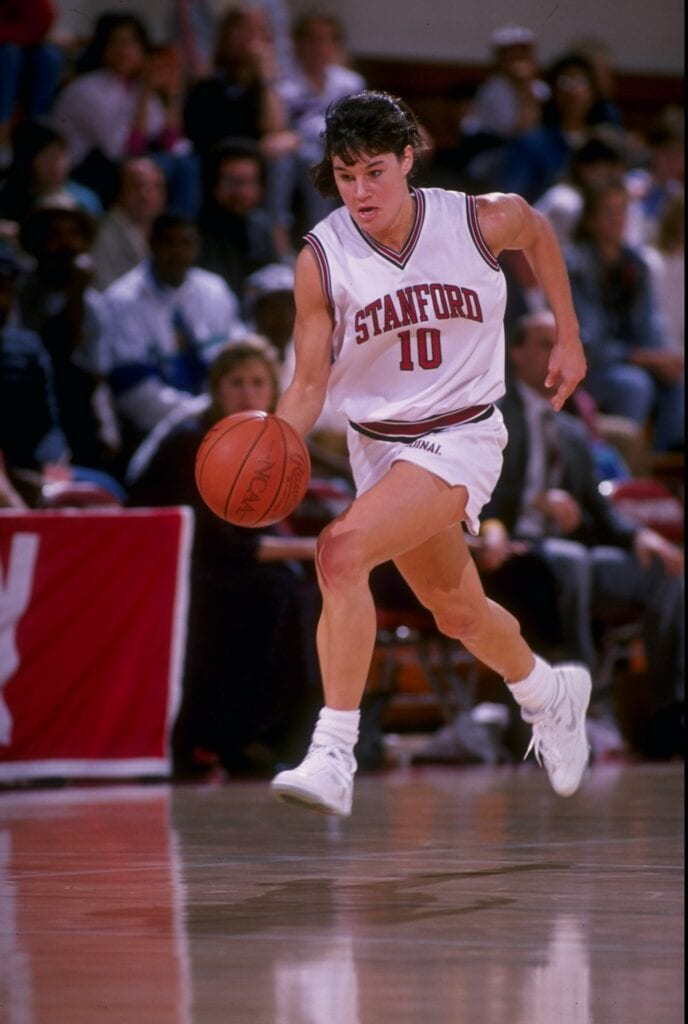
Before Azzi was an Olympic gold medalist with the 1996 Dreamers and a member of the WNBA Top 20@20, the point guard led Stanford to its first women’s basketball National Championship in 1990. They defeated Auburn, and her future Olympic teammate and WNBA foe Ruthie Bolton, in a thrilling 88-81 victory. Stanford trailed in the first half, but rallied back thanks to Azzi’s 17 points.
Stanford head coach Tara VanDerveer knew her Cardinals were going to win it all that 1990 season. She hung a sign on the locker room door: “1990 National champions. Get comfortable with it.”
“Not winning never entered our minds,” Azzi said.
That year, Azzi racked up the awards. She was named the Wade Trophy winner, Naismith Player of the Year, and the tournament’s most outstanding player. Azzi was drafted fifth overall in the 1999 WNBA draft by the Detroit Shock, who reached the playoffs in her first season. She then played three seasons with the San Antonio Silver Stars, leading the league in the 3-point percentage in both 1999 and 2001.
Sheryl Swoopes, Texas Tech (1991–1993)
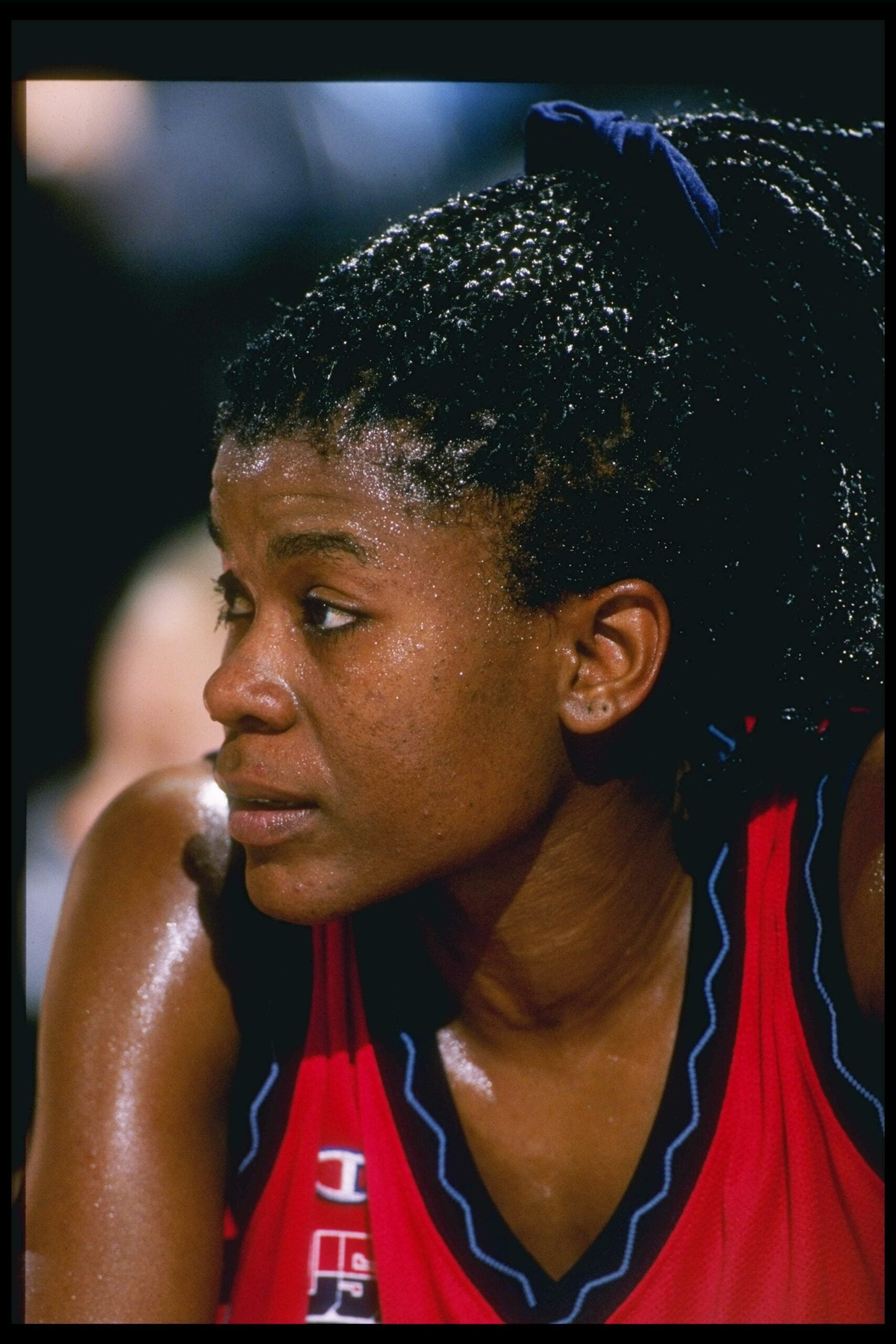
Swoopes was on a mission in 1993. Her Texas Tech Lady Raiders entered the tournament as the No. 2 seed in the West Regional and demolished everyone in their path to reach the National Championship game. They’d face No. 1 overall seed Ohio State, and future WNBA legend Katie Smith, for the title.
Swoopes scored a Final Four record of 47 points (16-24 from the field and 11-11 from the free-throw line) in the upset, being named the tournament’s Most Outstanding Player. Her 144 total tournament points (35.4 ppg) in a five-game stretch still holds 30 years later. It was her 17th 30-plus game.
“There are no words to describe what a great player she is,” head coach Marsha Sharp said of Swoopes then. “I’ve never seen a player who can dominate a game like she can. She’s the greatest player of her time, and she does everything with so much class. She has a certain charisma—it’s why all our people love her so much.”
It was not only women’s basketball’s first title, but it was also the first National Championship in any sport at Texas Tech.
The Texas native would go on to win the first four championships in WNBA history with the Houston Comets, and would finish her Hall-of-Fame career as a three-time MVP, six-time All-Star, and three-time Defensive Player of the Year.
Charlotte Smith, North Carolina (1991–1995)
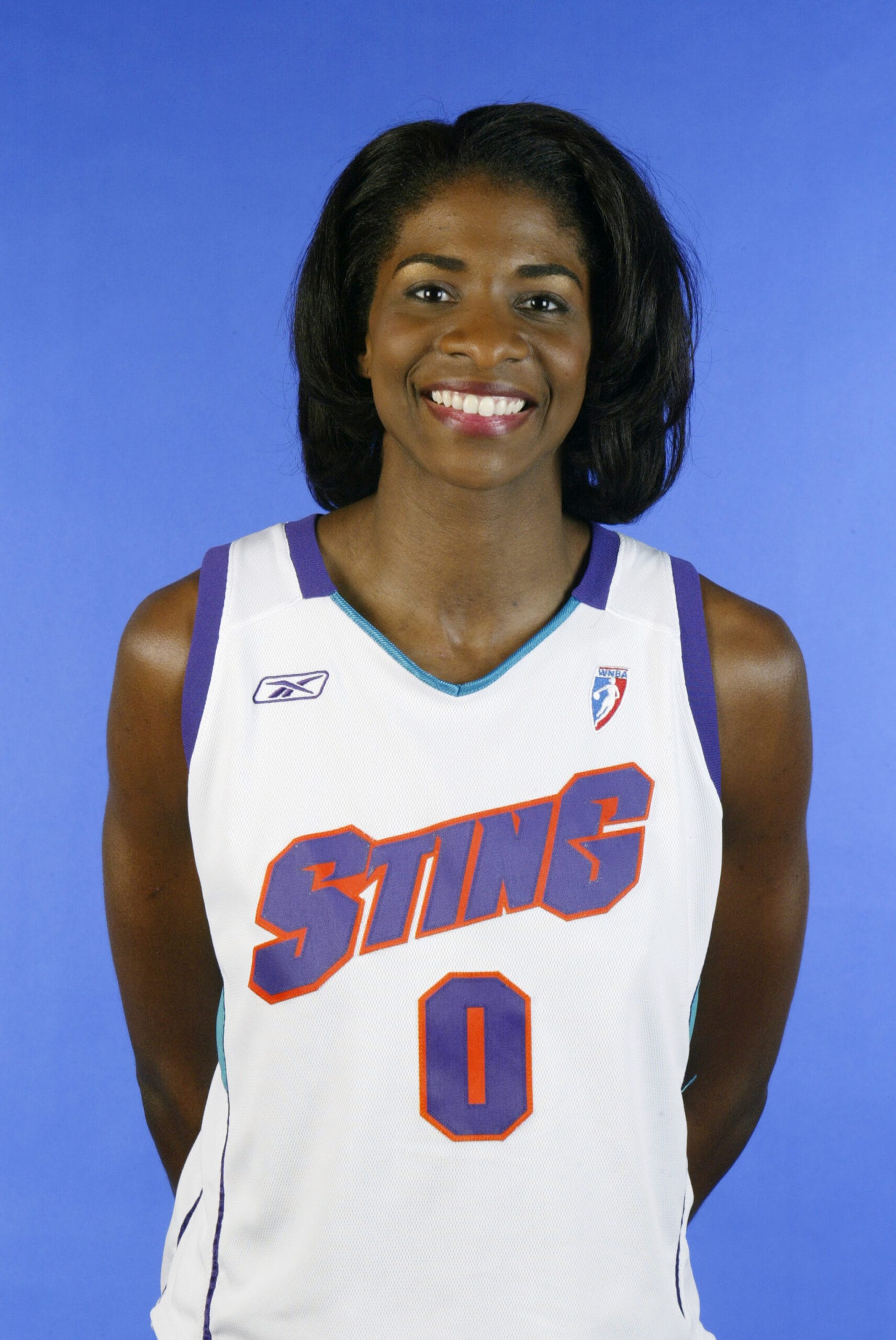
Trailing by two points with 0.7 seconds left, North Carolina’s coach Sylvia Hatchell burned back-to-back timeouts. The first huddle’s play was drawn for a 6-foot-5 center, Sylvia Crawley, to catch a lob and finish at the rim. But Louisiana Tech quickly caught on and clogged the paint. The next whistle, a new one was drawn up: a baseline out-of-bounds play that would go for the win. Junior forward Charlotte Smith started on the ball-side block in a box set. On the whistle, she screened diagonally. Tech’s miscommunication left Smith wide open for a weak-side 3. The hometown kid sinks it. UNC’s lone title is stamped as one of the most thrilling title finishes ever.
“When I look back at that moment, the magnitude of it is still pretty shocking because it created waves all over the world,” Smith reminisces. “It put not only women’s basketball on the map and UNC women’s basketball on the map, but Charlotte Smith became a household name.”
Smith was selected 33rd overall in the 1999 draft by the Charlotte Sting, then also played for the Washington Mystics and the Indiana Fever. She’d play eight seasons in the WNBA before getting into coaching; after serving as a long-time assistant coach at UNC, she took over at Elon University and led them to their first NCAA tournament bid in history.
Rebecca Lobo, Connecticut (1991–1995)
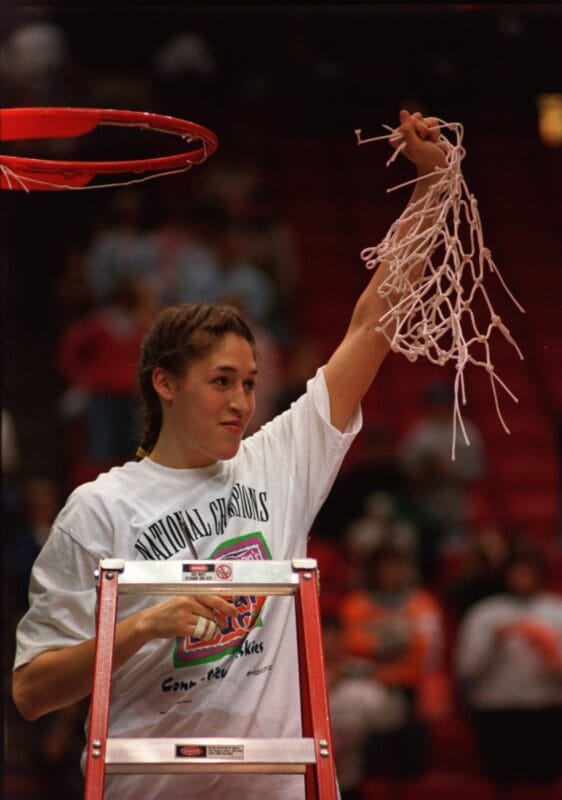
UConn’s first unblemished season came in 1995 with six-foot-four Lobo in the center, and it would go down as one of the most dominant seasons ever. They went a perfect 35-0, and won every regular-season game by double digits. They set the record for the highest average scoring margin at 33.2. (This season’s UConn team is winning by a whopping 37.8 ppg. Sheesh.)
Lobo was crowned the Naismith Player of the Year, the Wade Trophy, and AP Player of the Year for averaging a near double-double (17.1 points, 9.8 rebounds). Soon after the confetti and the national championship celebrations concluded, Lobo was headed to join Team USA — she skipped her college graduation to attend tryouts — and won gold with the 1996 Olympic squad.
She was one of the founding players of the WNBA with the New York Liberty, was an All-Star in 1999, and is a part of the Naismith Hall of Fame.
Chamique Holdsclaw, Tennessee (1995–1999)
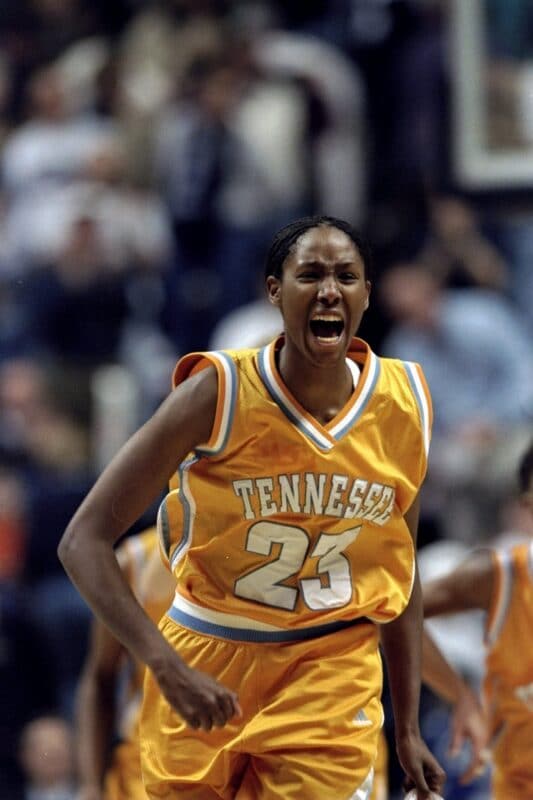
Before Holdsclaw was the No. 1 WNBA draft pick in 1999 and had a historic career for the Washington Mystics, she was wreaking havoc for Pat Summitt’s Tennessee Lady Vols. She’s the program’s all-time leading scorer and rebounder. She won three national championships (1996, 1997, and 1998), was the back-to-back MOP in 1997 and 1998, and was the back-to-back Naismith Player of the Year in 1998 and 1999.
She was also one part of the “Three Meeks”: Semeka Randall, Tamika Catchings, and Holdsclaw. Mik, Meek, and Mique. Not only did they share the same middle syllable, but they shared the same winning desire at Tennessee. “We wanted to go out there and dominate and embarrass people,” Holdsclaw would say decades later. During the 1998 season, they did. A perfect 39-0 with a fairytale national championship ending. They each knew their role: Randall was the floor general, orchestrating Summitt’s offense to a T. Catchings was the defensive wizard, picking pockets and taking names. Holdsclaw was a precisionist, slicing through the defense like she was a contestant on Iron Chef. Together, they molded into a three-headed Meekmonster, virtually impossible to contain.
Holdsclaw was a six-time WNBA All-Star, getting her first start as a rookie, and won Olympic gold in 2000.
Stephanie White, Purdue (1995–1999)
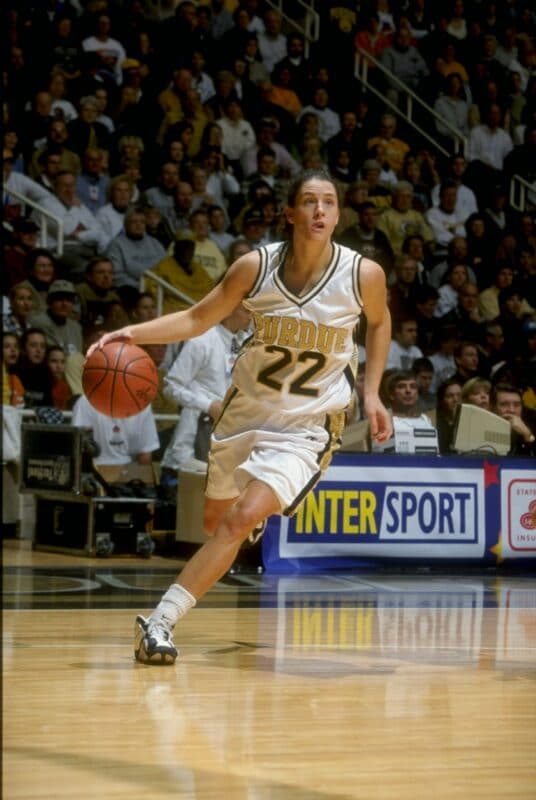
When the game clock struck zero on March 28, 1999, in San Jose, CA, Purdue’s All-American Stephanie White and her head coach Carolyn Peck were national champions. The top-ranked Boilermakers handily beat Duke, 62-45, despite White going down with a severe ankle injury with only four minutes to go in the contest. It was Peck’s last game before heading to the WNBA to be the coach and GM of the Orlando Miracle. The 17,753 fans in the San Jose Arena went wild, and chanted “One more year!” as she cut down the net.
They wish they could’ve said the same for White, who in her senior year nabbed the Big Ten Conference Player of the Year, Wade Trophy, and the Honda Sports Award while averaging 20.2 points per game. She’s still the Boilermakers’ third all-time leading scorer.
White was drafted by the Charlotte Sting in 1999, then played the rest of her six-year WNBA career with the Indiana Fever. But White took to coaching early on, even while she was still playing pro. In the WNBA, she’s made stops in Chicago and Connecticut, where she won Coach of the Year in 2023, before returning to the Fever as head coach in 2025.
Jordan Robinson is a freelance journalist, author, host, analyst, and content creator based in Los Angeles, CA.


,xPosition=.5,yPosition=.5)
,xPosition=.5,yPosition=.5)
,xPosition=.5,yPosition=.5)
,xPosition=.5,yPosition=.5)