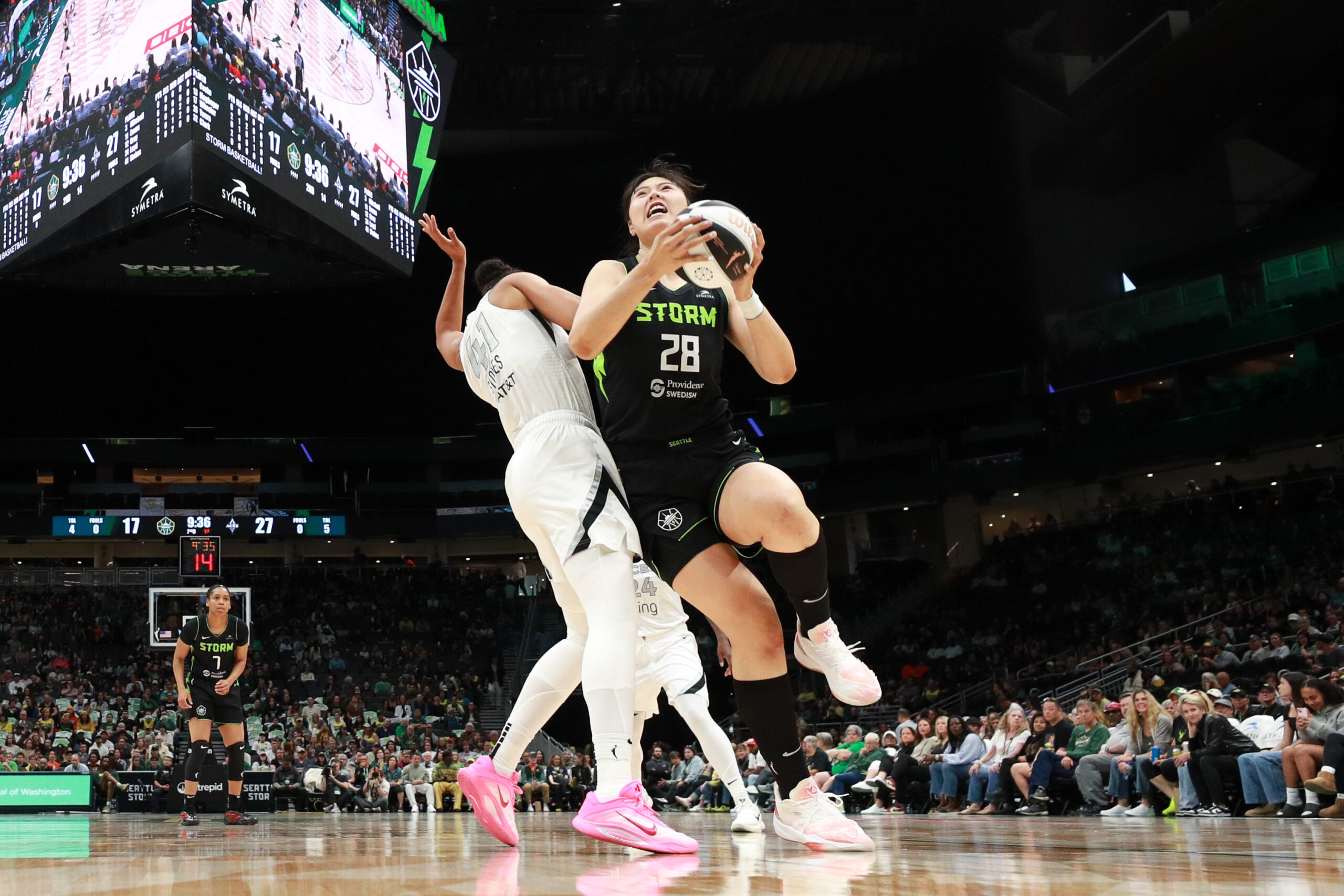
Possessions - Arguably the most important discovery made by statistical analysts in basketball is the critical importance of possessions. If a possession is considered as ending with a made shot, a defensive rebound or a turnover - that is, an offensive rebound is not a new possession - the two teams in any given games are essentially limited to the same number of possessions, other than the possibility of getting one extra possession in each half. Because of this, being more efficient in a game with your possessions means you will almost certainly win.
Where per-possession statistics are particularly valuable is in comparing teams that play at different paces. Pace is statistically defined as the number of possessions per game or per 40 minutes (to account for overtimes).
Possessions have actually been tracked on a game-by-game basis in the WNBA the last two seasons, but for longer periods we have to estimate possessions using the following formula:
Pos = .96 * (FGA + .44*FTA - OR + TO)
The .44 multiplier is because not all free throws take up a possession. Technical foul shots and "and-ones" do not, while there are more than two free throws on one possession with a three-shot foul. Research has determined that about 44% of all free throws take up possessions, thus .44 is used as the multiplier. The .96 multiplier accounts for team offensive rebounds in situations where a missed shot is tipped out of bounds by a defensive player, continuing the possession without an offensive rebound being credited.
Using this formula and averaging team and opponent paces, Phoenix (of course) played the league's fastest pace in 2006, averaging 80.6 possessions per 40 minutes. Indiana (74.1 possessions per 40 minutes) played at the league's slowest pace.
The Storm's Offensive Rating (102.7 points per 100 possessions) ranked fourth in the WNBA. Phoenix (108.5) dominated this category as well. Storm Coach
Anne Donovan coached the best offensive team in the WNBA by Offensive Rating three years running from 2002-04.
Defensive Rating - points allowed per 100 possessions - uses precisely the same theory, but at the defensive end of the court. Measured per 100 possessions, the Storm's Defensive Rating of 99.6 ranked eighth in the WNBA.
Per-Minute Statistics - Another important breakthrough for basketball analysts was finding that statistics calculated on a per-minute basis tend to be fairly consistent even when a player changes her role and begins to play more minutes. This allows for a level playing field in comparisons of low-minute reserves (as long as they've played a reasonable number of minutes; most cut-offs are 250 or 500 minutes for the season) and starters. Sometimes, you'll hear this referred to as a player's rate; her "scoring rate", for example, would be points per minute. Traditionally, this rate is multiplied by the 40 minutes in a game so the numbers make more sense.
Stat/Min * 40
Lauren Jackson was second in the WNBA in points per 40 minutes last season at 27.6.
Rebound Percentage - While rebounds per 40 minutes is a very good way to evaluate rebounders, you can do even better by taking into account that some players have the opportunity to grab more rebounds than others. The most fair way to evaluate rebounders is by percentage of all missed shots when they are in the game that they rebound. (This is usually estimated by their team's and opponent's rebounds per minute). This is known as Rebound Rate or Rebound Percentage (Reb%).
Reb% = Reb / (((TmReb + OppReb)/TmMin)*Min)
Jackson (16.9%) was the top Storm rebounder in 2006 by this measure, ranking ninth in the WNBA. After two seasons as the league's best rebounding guard,
Betty Lennox finished second in 2006, grabbing 9.6% of available rebounds. Not bad for someone who stands 5-8. Detroit's
Cheryl Ford has dominated this category since entering the league; her 22.6% rebound percentage led the WNBA in 2006.
At the team level, rebound percentage takes into account the fact that good teams usually outrebound their opponents because defensive rebounds are easier to get than offensive rebounds. The total team rebounding percentage is the average of its offensive and defensive rebounding percentages.
Team OReb% = TmOReb / (TmOReb + OppDReb)
Team DReb% = TmDReb/ (TmDReb + OppOReb
Team Reb% = (Team OReb% + Team DReb%)/2
Player rebounding percentage can also be split into offensive and defensive rebounding, which can prove insightful because few players are equally adept at both. At the team level, there is actually surprisingly little relationship between offensive and defensive rebounding, probably because offensive rebounding depends heavily on whether the coach chooses to crash the boards or play back to prevent fast breaks.
The Storm's 53.8% rebound percentage ranked second in the WNBA in 2006, trailing only Detroit (54.0%), led by Ford. Seattle was fourth on the offensive glass and third on the defensive glass.
Shooting Efficiency - If there is an on-base percentage in basketball - a statistic that has traditionally been undervalued - it would probably be some measure of a player's efficiency in scoring points. There's a stereotype that all statistical analysts think someone like the NBA's Allen Iverson (who has a 42.3% career field-goal percentage) is a bad player that is untrue because Iverson's ability to create shots and get his teammates better looks is valuable. Still, being efficient with your shots is very important. The two most common ways of measuring the concept of shooting efficiency are Effective Field-Goal Percentage (eFG%) and True Shooting Percentage (TS%).
Effective Field-Goal Percentage was invented by current L.A. Clippers Coach Mike Dunleavy and popularized by the Rick Barry's Pro Basketball Bible series. It adjusts for the added value of three-pointers by counting them as 1.5 field goals, thus make it more fair to 3-point shooters than field-goal percentage.
eFG% = (FGM + .5*3PM)/FGA
True Shooting Percentage goes a step further by factoring in a player's performance at the free-throw line and considering their efficiency on all types of shots.
TS% = Pts/(2*(FGA + (.44*FTA)))
Jackson had
one of the best True Shooting Percentages in WNBA history in 2006, posting a 65.9% mark that easily led the league. Jackson also led WNBA regulars in effective field-goal percentage (57.5%).
Linear weights - The most common way of evaluating players' overall ability is through the use of what's known as "linear weights" formulas, so named because they assign a weight to each statistic (rebounds, steals, points, etc.) and add or subtract them. The most commonly used linear weights are the WNBA.com Efficiency System and John Hollinger's Player Efficiency Rating (PER). 15 is average for Hollinger's PER, bigger numbers better and smaller worse - except when rating the performance of a player defensively, when you want the opponents to have smaller numbers.
Jackson's PER (37.3) topped the WNBA in 2006;
Diana Taurasi (30.0) was a distant second.
Plus-minus statistics - The current area of growth in NBA statistical analysis is in the field of plus-minus statistics. At its most basic level, plus-minus merely evaluates how well a player's team plays when he's on the court. This has been taken a step further by taking it on a per-40 minutes or per-100 possession basis and comparing it to how the team does without a player. The difference in these two is known as net plus-minus.
Paul Swanson of the Minnesota Lynx stepped up to offer complete plus-minus data for the WNBA in 2006 on the Lynx's official blog. Storm blog Chasing the Title also keeps track for the Storm. Here's the complete 2006 Storm plus-minus.