
Storm Excelled In Home Stretch, Carry Momentum Into Playoffs
When the WNBA returned from Olympic break, much was made about the final stretch of 10 regular season games, with the Sparks and Lynx running away with the standings and a logjam for every other spot. So evaluating now, who really made the most of that final 10-game stretch?
Well, top overall seed Minnesota, who finished 7-2. But for the case of argument, they didn’t truly need to have such a strong finish as they paced the league for much of the summer. The next best, and most valuable finish was 7-3, shared by the Chicago Sky (which is endlessly impressive and should heed warning to playoff teams as they achieved that mark with an injured and indefinitely out reigning MVP Elena Delle Donne) and the Seattle Storm.
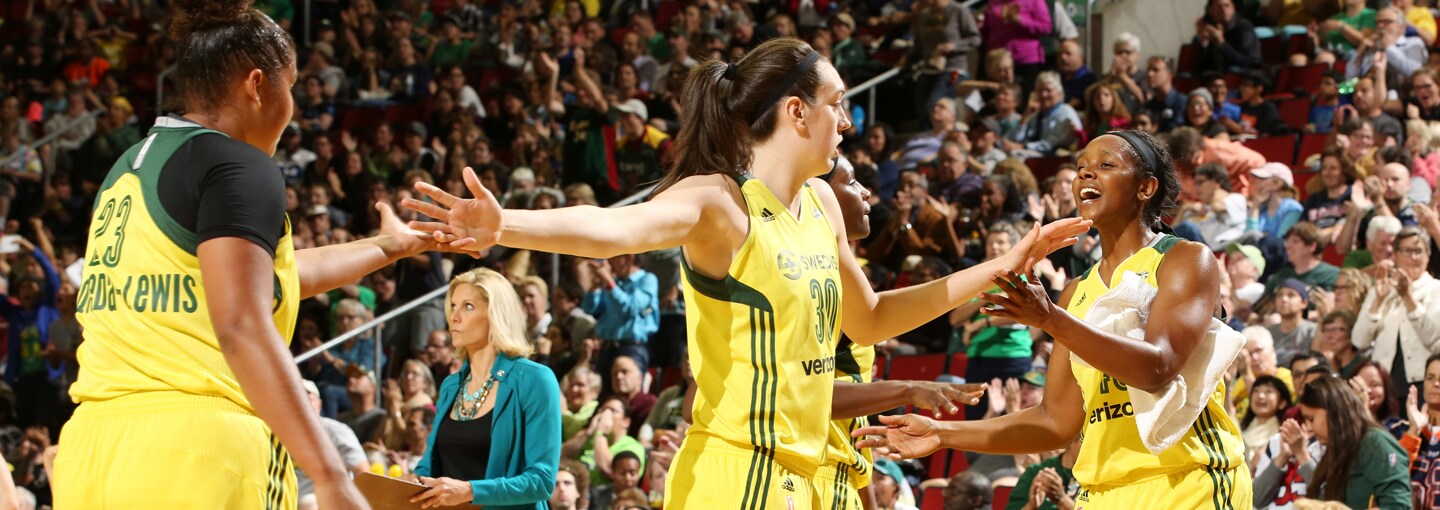
Returning their longtime leader Sue Bird and their astronomical rookie Breanna Stewart from a month of training with the best basketball players in the world, the Storm hit a higher level, going from a tie for the final seed to sole possession of 7th place. That boost has them playing their best basketball at the right time.
“It’s a good time for us to have some momentum,” said Alysha Clark, a key cog who’s bumped her offensive stats up to career highs: 9.0 points per game and 1.9 assists (not easy to amass aside a passmaster like Bird). “All season we’ve been right there in games, not finishing, and we’ve consistently gotten better. So now I think we’re coming together at the perfect time, and that’s exciting.”
Seattle’s final ten games included an impressive cocktail of wins: two victories over the 2nd-seeded Sparks, a road win at 3rd-seeded New York, another at then-hot Washington, and a reassuring W in the place they’ll need one next, Atlanta.
But the only game from that stretch of time that stands out to the Storm is a 24-point loss at Phoenix, who finish behind them in the postseason picture, in the last week of the season.
“I think you throw it away,” said captain Bird what to make of that game. “It kind of pointed some things out for us, the way we need to play. I don’t think we got overconfident. I think there was an emotional energy that got drained, spent, prior to the game. When we made the playoffs we relaxed a bit. And now we know we can’t relax.”
After finishing back on a high note with Sunday’s 88-75 win over Chicago, head coach Jenny Boucek admitted: “We had a dud in Phoenix. We want to go into the playoffs with a lot of momentum, so this game was a really good calibration game, a priming game, getting back to the way we want to play.”
Chicago, the other 7-3 finisher this season, was with Seattle step-for-step Sunday through three quarters, trailing 63-61, before the Storm went off to outscore them 25-14 in the final quarter. Bird thinks the team’s range of play in the final two games is the perfect teaching tool.
“We know what it feels like from that Phoenix game, and we know what this 4th quarter feels like.”
So where does the difference in play tangibly come from? Crystal Langhorne says it’s not a matter of offense, but defensively dictating when the opponent’s scoring chances end.
“We really focused on our defensive rebounding after the Olympic break, and I think that really helped us turn a corner,” said Langhorne Sunday. “We’re really talented offensively but we just tweaked a few things and that really helped us out.”
That post-Olympic corner turn was the team taking a pre-break record of 9-15 and a win percentage of .375 and ratcheting that up to .700. Seattle finished with the seventh-best defensive rebounding average at 24.5 a game and an eighth-best success rate of 72.1 percent of defensive rebounds snagged.
That statistical key was on display in the night-and-day games Seattle now use as their index. In Phoenix they lost the defensive rebound battle 26-24 and the percentage battle, 76%-72%. But against the Sky, the Storm were much more successful than their opponent, collecting a sky-high 86.2% of defensive rebound opportunities.
The stat was such a focus in fact that super rookie Stewart set a league record this season.
Your all-time leader for defensive rebounds in a single season, @bre_stewart30! #WatchMeWork #Stewie4DPOY pic.twitter.com/hhyhEwZkD4
— Seattle Storm (@seattlestorm) September 19, 2016
Now it’s time for young Seattle to test their blueprint in the Playoffs against a Dream team that, though they handled well in the regular season, presents unique concerns.
“Their strength is their athleticism and their ability to play a really unpredictable style,” said Boucek. “We have to bring a ton of energy.”
“It’s going to be a challenge,” said Bird. “I know we won two out of three [in the regular season] but I don’t think that’s really telling of anything.”
“We’re starting out on the road but the crowd gave us a great send off for the playoffs and we’re excited about it,” said Langhorne.
One person who refuses to get over-excited about the second season is Boucek, who still adheres to the season’s main objective: rebuilding for the long run. That’s where she knows the team’s best play lies.
“I still think it’s ahead of us,” said Boucek. “This team has a high ceiling. We won’t reach our potential this season. This is a multi-year plan. We want to reach as far a point as we can this season, and get better every second of it. And we’ll start with that next season and we’ll keep building. Our goal is championships here.”
Emphasis on the plural for Seattle.


,xPosition=.5,yPosition=.5)
,xPosition=.5,yPosition=.5)
,xPosition=.5,yPosition=.5)
,xPosition=.5,yPosition=.5)